

Your crew see everything. CrewLoop makes sure you hear it.
Helps with cabin, service and equipment issues that get lost in WhatsApp groups and paper forms, and problems that keep coming back because nobody owns them.
Show · tap the microphone
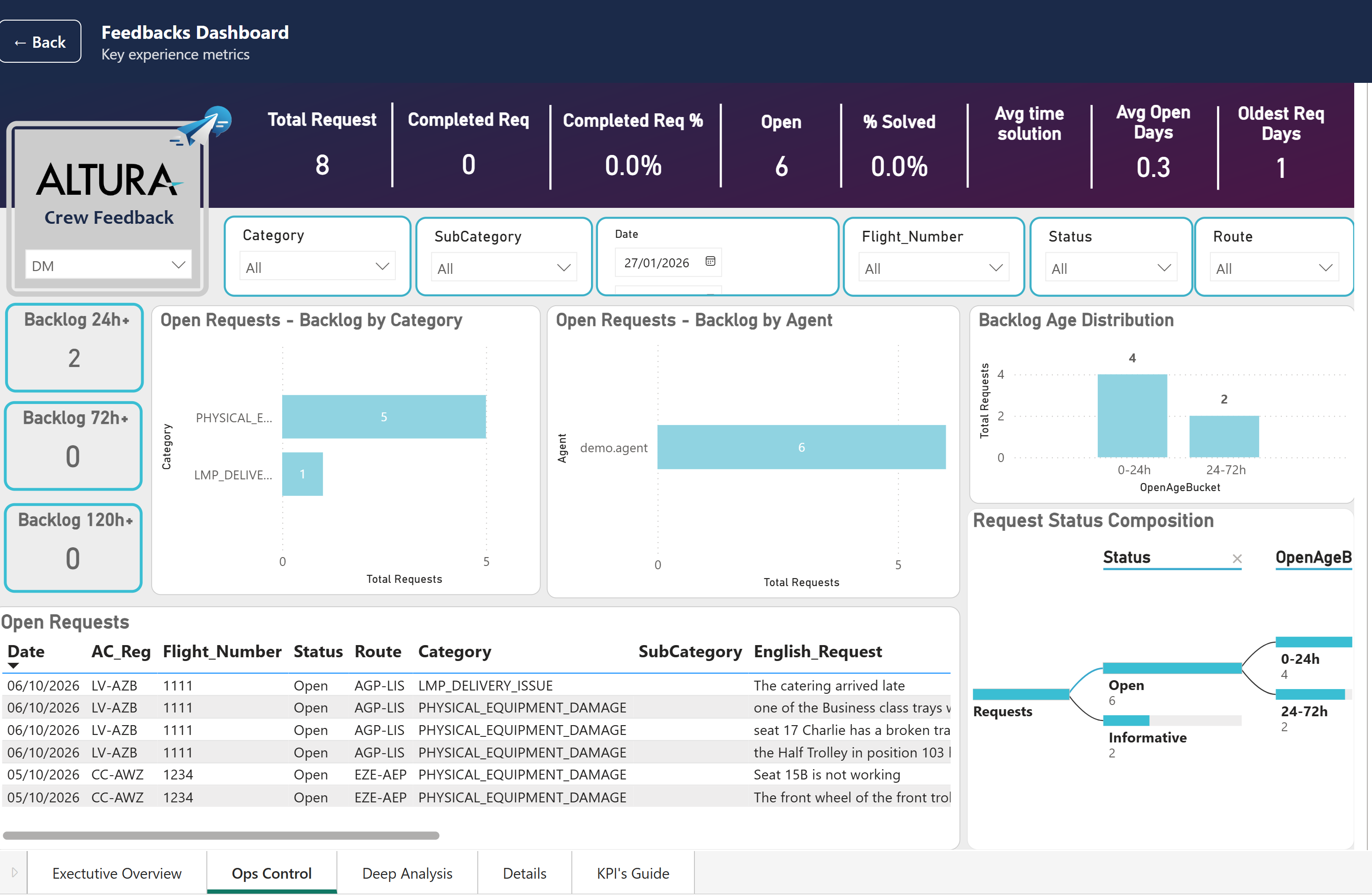
Illustrative screens. Ask the team for a live demo on the CrewLoop app.
Feedbacks Dashboard
Say
Why it matters
- Crew are closest to the passenger and see what works first. Most of that never reaches the people who could act on it.
- Every report gets an owner, a status and a resolution history, so nothing sits in a group chat.
- Altura runs onboard programmes daily, so the loop closes with our operations team behind it.
Ask them
- How does crew feedback reach your ops team today?
- How long before a cabin issue has an owner?
- Which issues keep coming back?
What they get
Proof point to add: results from a live airline once approved.
Crew are the only sales team that flies every route.
Helps with onboard sales that vary from crew to crew and base to base, training that stops after onboarding, and managers who can't see performance until it's too late.
Show · tap through the app
Show · cumulative training hours
Illustrative scenario: both paths include 2 hours of initial training and a 1-hour airline refresher at month 6. Short, irregular LUZ sessions add another 15 hours over the year, reaching 18 hours in total.
Show · sales per head (SPH)
Illustrative SPH index, starting at 100. The current model stays near 100; LUZ rises gradually to 110 over the year.
Illustrative screens. Ask the team for a live demo on the LUZ app.
Say
Why it matters
- Crew practise the sale before they ever step on the aircraft, so confidence is built on the ground.
- Badges, challenges and rewards crew choose themselves make training something they want to finish.
- Managers see performance the moment it happens, by crew and by base.
Ask them
- How do you keep crew selling after onboarding training?
- Can you see sales per head by crew member or base?
- Where do you think onboard revenue is leaking?
What they get
Proof point to add: sales uplift from an airline using LUZ, once approved.

The smartest reload may be the one you never make.
Helps with catering loaded to a fixed cycle whatever the flight needs, trucks rolling with most of the stock still onboard, and handling costs that eat 25–35% of retail revenue.
Show · one aircraft, 5 days
Illustrative rotation: six flights per day, each using 1–4% of a full barset. The same demand is used for both schedules; stock can run out before the next barset loading. Full availability here means ending a flight with at least 40% stock. A simulation on the airline's own data shows their real figures.
Show · their fleet
Assumes two loading visits per aircraft per day. Each barset cycle has one barset loading; the remaining visits are vantrips. Costs shown here are illustrative: replace them with the airline's figures.
Annual saving
Say
Why it matters
- Loadings are driven by rotation count, so the truck comes whether the flight was half full or full.
- LoadIQ checks what's still onboard and what the next sectors will sell, then decides if a loading is needed.
- It's a managed service. Our ops specialists confirm every plan, so there's no software to run and no crew, product or supplier change.
Ask them
- Do you reload barsets on a fixed cycle or on demand?
- How many loadings per aircraft per day?
- What does a single loading cost you?
Proof

Sell onboard without the legal and finance headache.
Helps with airlines running retail in-house who carry the seller's legal, tax and payment obligations in every country they fly to, often without a team set up for it.
Show · who carries what
Each brick is a seller responsibility. Tap either button to see how it is carried.
Say
Why it matters
- The Merchant of Record is the legal seller behind every onboard sale, the name on the receipt.
- Running it in-house means a VAT registration in every territory, fiscal rep fees, compliance software, advisory and audit costs, and penalty exposure.
- Altura holds that legal and financial position as a service. The airline keeps the commercial decisions.
Ask them
- Whose name is on your onboard receipts today?
- How many countries do you sell into?
- Who handles VAT, chargebacks and refunds?
What they get
Proof point to add: cost of compliance avoided for an example airline, once approved.
Visitors to follow up
Everyone saved on the stand, with what they saw and the follow-up agreed. Newest first.